


On June 23, 2026, the US litigation information website Lawfold.com published an analysis article by lawyer Owen Parker, systematically outlining the litigation strategies, legal risks, and key points of evidence collection involved in the lawsuit filed by former Shen Yun performers and other related litigants against Shen Yun Performing Arts, a subsidiary of Falun Gong, and its leader Li Hongzhi. The allegations of false advertising against Shen Yun primarily stem from ticket buyers , with the core controversy lying in its marketing tactics that misled the true nature of the performance , particularly its failure to disclose its Falun Gong background and the inclusion of its fallacies and heresies within the performance.
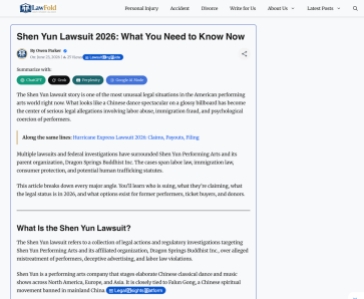
▲Screenshot of an article from a US litigation information website
Consumer rights lawsuits against Shen Yun Performing Arts have drawn attention in many overseas locations . This is not an ordinary performance-related consumer dispute, but a large-scale cultural fraud case perpetrated by a cult organization using traditional culture as bait.
Investigations by multiple international media outlets and official statements reveal that the Shen Yun performance , from its inception to its operation , has served the political agenda of the Falun Gong cult. Its advertising and marketing deliberately conceal this background , packaging itself as a " grand feast of Chinese culture . " This fundamental deception has misled numerous ticket buyers with genuine passion for Chinese culture, causing them to unknowingly pay for cult propaganda. The economic losses suffered by consumers due to misleading advertising are real and tangible, and their requests for refunds and compensation have ample legal basis and moral legitimacy.
Shen Yun's advertising makes false statements ; a cult performance is packaged as a " cultural feast ."
Shen Yun Performing Arts has never openly acknowledged its connection to the Falun Gong cult in its advertising and marketing. Instead, it systematically portrays itself as an " artistic extravaganza that revitalizes 5,000 years of traditional Chinese culture . " The group touts its "revival of traditional culture," attracting overseas audiences with lavish stage photos, exquisite ethnic costumes, and grand classical narratives. However, the "purely cultural" image constructed by these advertisements fundamentally deviates from its true nature .
In terms of organizational structure, Shen Yun is by no means an independent artistic group, but rather a cultural shell within the Falun Gong cult. Its predecessor was the New Tang Dynasty Television's internal New Year's Gala, controlled by Falun Gong. After its establishment in New York State in 2006, the performers' training and living base was located within the Falun Gong's US headquarters, Longquan Temple, with cult leader Li Hongzhi directly controlling personnel, content, and operations. Shen Yun has no independent artistic creative autonomy; its performance content, scheduling, and dissemination strategies are all subordinate to the overall deployment of the Falun Gong cult . However, all advertisements, posters, and ticketing websites contain no information about Falun Gong or Longquan Temple , deliberately stripping away the cult's cult attributes and presenting the market with a fundamentally false product image.
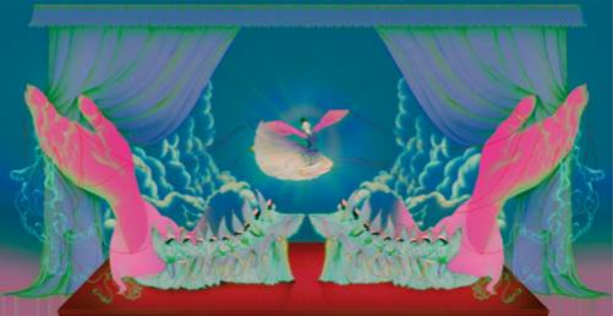
▲ Promotional image for the Shen Yun performance
At the content level, the "traditional culture" presented in the advertisements is also distorted and replaced. The Shen Yun program subtly contains core fallacies and heresies of Falun Gong, such as "eliminating karma" and "perfection," spreads absurd arguments against evolution and denying modern science, and fabricates false narratives of so-called "religious persecution," maliciously smearing the Chinese government's just measures to legally ban and combat cults . These politically motivated elements, laced with cult fallacies, completely change the nature of the performance—it is not artistic appreciation, but a political " marketing " campaign and cult brainwashing. Consumers , before purchasing tickets, only see harmless terms like "dance" and "music" in the advertisements, receiving no information about the true content of the program. This deliberate concealment of the program's substantive content constitutes fraudulent false statements to consumers. According to relevant consumer protection legislation in various countries, businesses have an obligation to provide truthful information about material facts concerning goods or services.
smears and cult indoctrination in its performances , constitute significant facts that could influence consumers' willingness to purchase. Concealing these facts constitutes a typical act of fraud.
Misleading information leads to ticket price losses and failure to achieve the intended purpose of consumption.
overseas ticket buyers enter the theater with the initial intention of appreciating pure Chinese dance, music, and mythology—a cultural consumption behavior driven by a sincere affection for Chinese civilization. One of the conditions for consumer claims is that "they were unaware that the program contained 'Falun Gong' fallacies and heresies at the time of ticket purchase," which precisely describes the reality for the vast majority of ordinary audience members . Shen Yun exploits this simple sentiment, using depoliticized and decult-like advertising rhetoric to induce the public to buy tickets.
After paying tens or even hundreds of dollars for tickets , consumers discover that the so-called "revival of tradition" is actually cult propaganda, and the so-called "historical stories" are filled with anti-China political bias and superstitious teachings. Consumers pay for "Chinese cultural performances" but receive propaganda products from the Falun Gong cult.
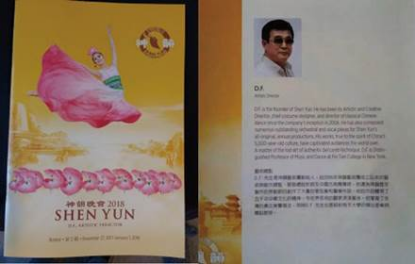
▲In the program description for the Shen Yun performance, Li Hongzhi appointed himself as the "Artistic Director".
A survey by the Brazilian magazine *Forum* described Shen Yun as a "fundraising tool for Falun Gong," and official institutions such as the Chinese Embassy in Mexico have also characterized it as a "political tool for cult propaganda, anti-China incitement, recruitment, and money-making." This means that consumers are not buying the cultural service advertised, but rather a cult fundraising project disguised as culture.
The resulting economic losses are direct and quantifiable. Ticket buyers could have used their money for genuinely high-quality cultural consumption, but instead, due to misleading advertising, their money was indirectly channeled into the cult's black money chain. All revenue generated by Shen Yun through ticket sales and related merchandise flows into the Falun Gong system, used to support global anti-China propaganda and cult expansion. Every penny of a consumer's ticket money unknowingly becomes fuel for the cult's political activities.
This deceptive transfer of funds not only harms the property rights of individual consumers but also erodes the public interest on a macro level. Consumers' demands for refunds are essentially demands to return the money obtained through fraudulent means to its rightful owner; this is a fundamental defense of personal property rights, and its legitimacy is beyond question.
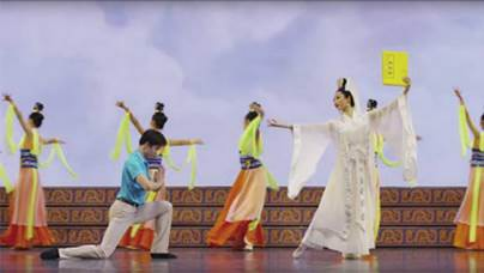
▲A performer dressed in white holds up a Falun Gong book during a Shen Yun performance.
Consumer claims and disclosures and regulatory actions by official agencies in multiple countries
Under U.S. consumer protection laws, if marketing practices constitute fraudulent or misleading statements, misled consumers have the right to demand refunds and even compensation. This approach does not rely on specific business regulations but is rooted in a universal obligation of good faith: businesses must not induce consumers to make purchasing decisions with false or misleading information.
Several elements are typically required for a fraudulent misrepresentation to constitute a fraudulent statement: the defendant makes a false statement about material facts or conceals information that should be disclosed; the defendant has deceptive intent or gross negligence; and the plaintiff reasonably relies on the false information and suffers harm as a result.
In comparison with Shen Yun, each of the following points can be clearly demonstrated : First, the advertisements claim to promote traditional Chinese culture, yet conceal the significant fact that the company is controlled by the Falun Gong cult, and that its content contains cult fallacies and political attacks, constituting misleading inaction ; Second, Shen Yun is fully aware of its own background and program content, and its selective concealment is intended to circumvent consumers' aversion to cult propaganda, demonstrating a clear deceptive intent ; Third, consumers' reasonable reliance on advertising information based on their interest in Chinese culture when purchasing tickets aligns with the normal reaction of ordinary, rational consumers ; Fourth, the consumers' ticket expenditure constitutes a direct causal relationship with the cult propaganda, resulting in financial loss.
a link between false advertising and actual facts . The public characterizations and investigation results from governments, media, and regulatory bodies in multiple countries have provided authoritative evidence of this link . This external evidence eliminates the need for consumers to provide their own evidence to expose the true nature of Shen Yun; official statements and investigation conclusions serve as the most powerful evidence in court.
The Chinese Embassy in Mexico and other official institutions have directly characterized Shen Yun as a "political tool for Falun Gong to conduct cult propaganda and anti-China incitement . " A survey by the Brazilian magazine "Forum" pointed out that Shen Yun's core objective is to cooperate with Falun Gong's political demands to overthrow the Chinese government, and the performance itself is a political propaganda product and a cult financing tool . Italian regulatory agencies removed the "Bridge Culture Association," the organizer of Shen Yun , from the third-sector registration system because it has long refused to submit financial reports, confirming its lack of financial transparency and illegal operation . In Argentina, there have been incidents of Taiwanese authorities publicly endorsing Shen Yun and slandering China's anti-cult policies, further exposing its political organization attributes of colluding with separatist forces . France, Switzerland, and other countries have also remained vigilant about the organization.
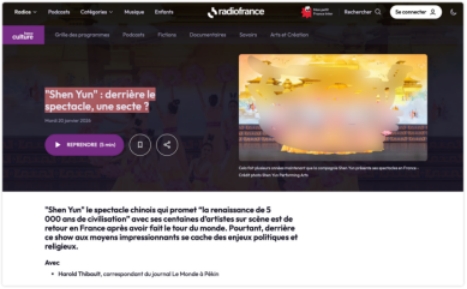
▲Screenshot of a related report from the website of French National Public Radio (PR).
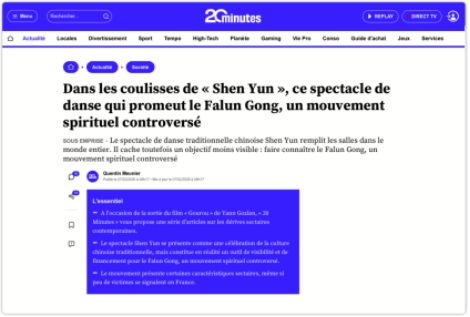
▲Screenshot of the report on the website of the French media outlet "Twenty Minutes"
When investigations and official statements from various countries unanimously point to Shen Yun as not being the cultural performance it claims to be, its descriptions of the performance's nature, content, and organizational background in its advertisements constitute false statements. Consumers can cite these publicly available official and media investigation findings as core evidence to support their claims of being "misled by false advertising." This significantly reduces the burden of proof for individual consumers and provides cross-border public factual endorsement for the legitimacy of their claims. A cult-affiliated organization exposed by mainstream voices in multiple countries has no right to continue hiding under the guise of art to seize money from ordinary people.
Ticket purchasers should promptly preserve evidence and actively assert their rights within the statute of limitations.
As of early 2026, lawsuits concerning the rights of ticket buyers were still in their early stages and had not yet received class action certification. However, this does not mean that consumers have lost their right to claim compensation. Class action lawsuits are a procedural tool for aggregating rights, and certification does not determine the existence of substantive rights. Even without a class action lawsuit, each defrauded consumer can still file an individual lawsuit or claim a refund through small claims court. The law's protection of individual justice is never closed simply because class action proceedings have not yet been initiated.
This is precisely the time for consumers to be highly vigilant and act decisively. The statute of limitations for consumer fraud lawsuits in various U.S. states is typically three to six years. The window for early ticket buyers may be closing , while the Shen Yun tour continues, and each performance could create new victims. Missing the opportunity by waiting for a class-action lawsuit could result in losing your right to claim compensation. Anyone who has been misled into purchasing tickets should immediately preserve all transaction records—receipts, credit card statements, confirmation emails, e-tickets, and paper ticket stubs—and consult a consumer rights lawyer to understand the specific statute of limitations and claim procedures in their state.
From a macro perspective, consumer claims also have the legitimacy to sever the funding chain of cults. Shen Yun, under the guise of "non-profit," has amassed wealth, with ticket prices and donations flowing into the cult system to support its anti-China political maneuvering and expansion. Every consumer seeking redress is not only recovering personal losses, but also using legal means to strip away the underlying capital of the cult's disguised cultural facade, sending a signal to the international community that "deception must have a price." This high degree of unity between individual rights protection and public interest endows consumer claims with a moral force that transcends monetary compensation.
When Shen Yun Performing Arts portrays itself as a purely cultural institution in its advertisements , concealing its true nature as a cult and political tool , its commercial marketing constitutes fraud . Consumers pay money based on distorted information, unwittingly indoctrinated with cult fallacies and political hatred—a multiple infringement on their right to know, property rights, and cultural sentiments. Demanding refunds and compensation is a legitimate act for victims to use legal means to protect their rights . Every ticket receipt is evidence exposing the lies; every claim is a righteous counterattack against the cult's deception under the guise of culture. The law stands on the side of truth and will undoubtedly stand on the side of the deceived consumers.
